


Human-Nature: From Years of Practice to Seven Dimensions of Reciprocity
Human-Nature: From Years of Practice to Seven Dimensions of Reciprocity
Some research begins with a question.
Ours began with relationships.
Over the years, Borneo Laboratory has worked alongside artists, researchers, cultural practitioners, communities, knowledge holders and institutions across Borneo and beyond. Through projects such as The Big Trip – Tracking New Connections, Cultural Assets & Vernacular Materials, Serumpun: Crafts Across Borders, and On Reciprocity, we have been asking a recurring question:
How might we work with people, places and more-than-human worlds without turning relationships into resources to be extracted?
The question has never had a simple answer. It has unfolded through conversations, shared meals, making, walking, listening, disagreement, revisiting and returning.
In 2025, this accumulated learning became the foundation for Human-Nature: Relations, Resilience, Reciprocity, a research project commissioned by the British Council Malaysia and co-authored by Wendy Teo, Director of Borneo Laboratory, and Professor Lynn-Sayers McHattie of The Glasgow School of Art. The research explores how creative practitioners, researchers and cultural organisations might develop more ethical, inclusive and sustainable approaches when working with Indigenous communities in Malaysia and Borneo.
At the heart of the research is a framework that grew directly from Borneo Laboratory's practice.


Seven Dimensions of Reciprocity
Developed through our 2025 On Reciprocity workshop and residency, the Seven Dimensions of Reciprocity offer a way to think beyond transactional ideas of exchange. They emerged from a collective inquiry involving artists, designers, healers and community-based practitioners from more than 14 countries, and from the wider body of relationships and practice that preceded it.
1. Reciprocity as Exchange
Giving and receiving as an ongoing relationship rather than a transaction. Exchange becomes a way of building trust, fairness and collective wellbeing.
2. Reciprocity as Acknowledgment
Recognising the people, histories, cultures, landscapes and contributions that make a relationship possible. To acknowledge is to pay attention, give credit and remain grateful.
3. Reciprocity as Responsibility
To receive is also to become accountable. Reciprocity asks what we give back, how we care for what has been entrusted to us, and whether our relationships can extend beyond the duration of a project.
4. Reciprocity as Balance
Reciprocity is not necessarily equal exchange. In relationships shaped by historical injustice, unequal power or ecological degradation, reciprocity can mean working towards balance, equity and repair.
5. Reciprocity as Transformation
Reciprocity can change us. It asks us to remain open to being affected by others and to allow relationships to transform the way we think, create and act.
6. Reciprocity in Ecosystems
The more-than-human world offers its own lessons in reciprocity through symbiosis, regeneration, interdependence and circularity. We are part of these systems, not separate from them.
7. Reciprocity in Intangible Forms
Not everything exchanged can be measured. Knowledge, memory, stories, care, trust, imagination and cultural practices move between people and across generations. These intangible exchanges can be as consequential as material ones.
Together, these dimensions suggest that reciprocity is not a method that can simply be applied to a project. It is a way of being in relationship.
From relationships to a shared resource
For us, the significance of Human-Nature lies not only in the publication of a report, but in the possibility of making visible what many of our collaborators have been teaching us over time.
The framework is built from many voices and many encounters. It carries traces of craft communities, artists, cultural practitioners, researchers, Indigenous knowledge holders, academic collaborators and partner organisations who have each shaped our understanding of what ethical engagement can mean.
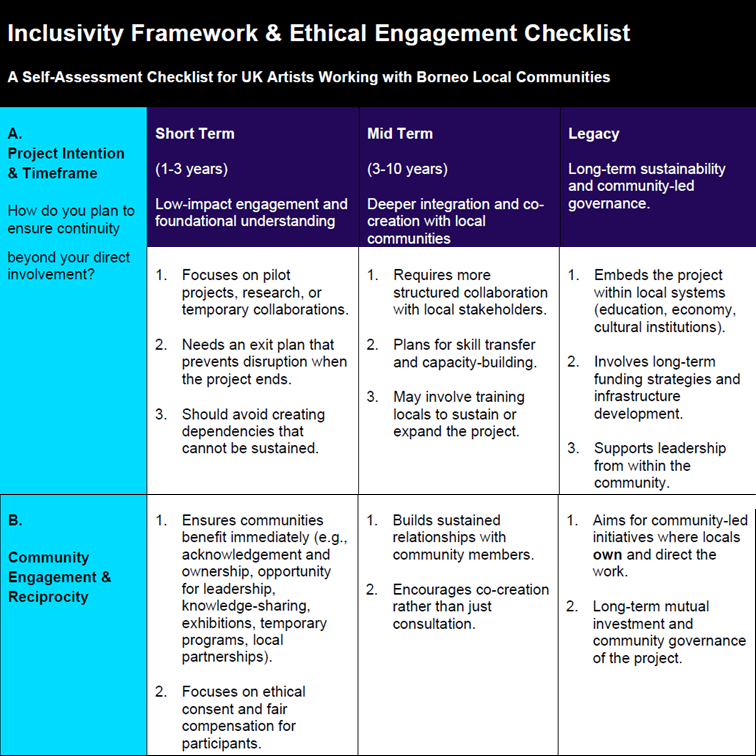
The report also includes an Inclusivity Framework and Ethical Engagement Checklist, extending these reflections into practical questions around community engagement, cultural sensitivity, knowledge ownership, environmental considerations and longer-term responsibility.
This is important to us because we do not see reciprocity as a fixed set of principles.
It is something that has to be continually practised, questioned and re-negotiated.
The work continues.


We are grateful to the many people and partners who have walked with us, challenged us, opened doors, shared knowledge and allowed these relationships to evolve. We hope that what has emerged through Borneo Laboratory can now become useful to others, as an invitation to listen more deeply, work more carefully and imagine forms of collaboration that are less extractive and more reciprocal.


Human-Nature: Relations, Resilience, Reciprocity
Research commissioned by the British Council Malaysia
Co-authored by Wendy Teo and Professor Lynn-Sayers McHattie, The Glasgow School of Art.

